Posts

Showing posts with the label Art Supply

Chrome Green Safety Guide

Image
  What is Chrome Green? Chrome Green, also known as chromium(III) oxide, eskolaite, chromic acid green, and viridian, is an inorganic compound. Chrome green is commonly used as a pigment in paints, glass, and banknotes. It also has use in metallurgy and as an abrasive. Chrome Green has the CAS Number 1308-38-9. The CAS Number is used to identify chrome green as an ingredient on safety data sheets (SDS) and other safety documentation. When looking for chrome green as an ingredient in products like paints, look for the CAS Number in the composition table. Notable Properties of Chrome Green Chrome green is green to blue-green in color and tends to be in a powdered form. It is naturally odorless. What Makes Chrome Green Hazardous? Chrome Green is an irritant and can affect the skin, eyes, and respiratory system. In addition to being an irritant, chrome green, along with other chromium compounds, can cause chromium sensitivity. This leads to a chromium allergy . The toxi...

Manganese Black Safety Guide

Image
  What is Manganese Black? Manganese Black is a mineral compound also known as manganese dioxide, manganese (IV) oxide, pyrolusite, cement black, pigment black 14, and pigment brown 8. Manganese black has many uses, including as a component in dry-cell batteries, and as a pigment. Manganese Black has the CAS Number 1313-13-9 The CAS Number is used to identify manganese black as an ingredient on safety data sheets (SDS) and other safety documentation. When looking for manganese black as an ingredient in products like paints, look for the CAS Number in the composition table. Notable Properties of Manganese Black Manganese black is dark grey to brownish black in color and tends to be in a powdered form. It is naturally odorless. Pyrolusite is the mineral name for manganese dioxide and is the most common mined source for manganese used in industrial processes. What Makes Manganese Black Hazardous? Manganese black is considered a respiratory irritant. Breathing in manganese black powder...

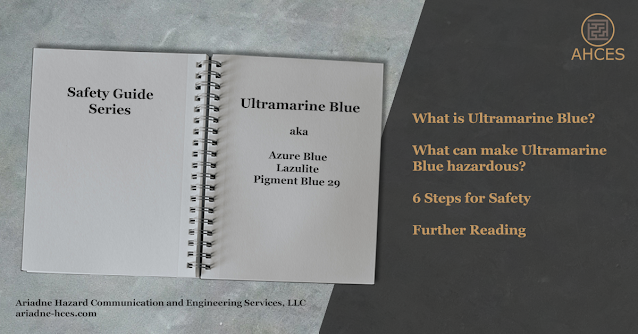
Ultramarine Blue Safety Guide

Image
    What is Ultramarine Blue? Ultramarine Blue, also known as azure blue, lazulite, and pigment blue 29, is a mineral, both natural and synthetically derived. Historically, ultramarine blue was made from ground lapis lazuli or lazulite. In modern times, synthetic ultramarine blue is the most common form available to consumers. Ultramarine blue is commonly used as an artist's pigment in paints, as well as a pigment in pottery glaze. Ultramarine blue has the CAS Number 57455-37-5. The CAS Number is used to identify ultramarine blue as an ingredient on safety data sheets (SDS) and other safety documentation. When looking for ultramarine blue as an ingredient in products, look for the above CAS Number within the composition table. Notable Properties of Ultramarine Blue Ultramarine blue is a sulfur-containing, sodium-aluminosilicate. Ultramarine blue is known for its brilliant blue color, making it a popular pigment. Synthetic ultramarine blue tends to be a brighter, more intense b...

Acetone Safety Guide

Image
  What is Acetone? Acetone, also known as 2-propanone, dimethyl ketone, or beta-ketopropane, is a type of methyl ketone. In industrial applications, it is used in the production of methyl methacrylate and bisphenol A, which are plastic precursors. It is also a commonly used solvent in household applications, notably as nail polish remover and paint thinner. Acetone has the CAS Number 67-64-1. The CAS Number is used to identify acetone as an ingredient on safety data sheets (SDS) and other safety documentation. When looking for acetone as an ingredient in products, look for the above CAS Number within the composition table. Notable Properties of Acetone Acetone is a clear liquid, with a distinct sweet odor. It is a polar, aprotic solvent which is what makes it useful in multiple solvent applications. What Makes Acetone Hazardous? Acetone is highly flammable. It produces vapors that are heavier than air, which means that the vapors can more easily gather in dangerous concentrations w...

Oxalic Acid Safety Guide

Image
  What is Oxalic Acid? Oxalic Acid is a dicarboxylic acid naturally produced by plants of the genus Oxalis, also known as wood-sorrels. Oxalic acid has many uses including in rust removal and other household cleaners, bleaching agents for wood pulp, and as a mordant in the dyeing process. Oxalic Acid the CAS Number 144-62-7. The CAS Number is used to identify oxalic acid as an ingredient on safety data sheets (SDS) and other safety documentation. When looking for oxalic acid as an ingredient in cleaning products, bleaches, and mordants, look for the CAS Number within the composition table. Notable Properties of Oxalic Acid Pure oxalic acid is a white, odorless crystalline solid, typically found in powder form. Any color or odor comes from natural impurities or other ingredients within the oxalic-acid-based product. What Makes Oxalic Acid Hazardous? Oxalic acid is, as the name suggests, an acidic substance. It can cause irritation to the eyes, skin, and respiratory sys...

Titanium Dioxide Safety Guide

Image
What is Titanium Dioxide? Titanium Dioxide is a naturally occurring inorganic compound. Titanium dioxide can be found in a wide range of applications, including as a pigment for increasing brightness and opacity in paints, coating, plastics, cosmetics, and foods. Titanium dioxide is also known by the mineral names anatase, brookite, and rutile. It is also known as titanium (IV) oxide, titanium peroxide, and by the pigment name titanium white. T itanium Dioxide has the CAS Number 13463-67-7. The CAS Number is used to identify titanium dioxide as an ingredient on safety data sheets (SDS) and other safety documentation. When looking for titanium dioxide as an ingredient in pigments, colorants, and finishes, look for the CAS Number within the composition table. Notable Properties of Titanium Dioxide Titanium dioxide is naturally an odorless white solid, often found in a powdered form. It is UV resistant and considered inert, not readily reacting with oxidizers, acids, or bases. Any other c...

Mica Powder Safety Guide

Image
What is Mica Powder? Mica is a group of natural hydrous silicate minerals noted for their lustrous shine, which makes it a popular additive in powder pigments. Mica can be found both in cosmetics and in artists' pigments used in painting, epoxy resin, soapmaking, and other crafts. Mica groups several different naturally occurring hydrous silicate minerals, including the more common biotite and muscovite, as well as lepidolite, margarite, phlogopite, roscoelite, and zimmwaldite. Mica has a CAS Number 12001-26-2. The CAS Number is used to identify mica as an ingredient on safety data sheets (SDS) and other safety documentation. When looking for mica as an ingredient in pigments, colorants, finishes, or other materials, look for the CAS Number within the composition table. Notable Properties of Mica Powder Mica is most noted for its lustrous shine or shimmer due to the shape of the hydrous silicate crystals. It is naturally colorless and odorless, with any color or odor coming from na...