Posts

Showing posts with the label DOT

Introduction to DOT Limited Quantitites

Image
  What is a DOT Limited Quantity? The formal definition of a Limited Quantity from the Pipeline and Hazardous Materials Administration (PHMSA) is as follows: Limited quantity, when specified as such in a section applicable to a particular material, means the maximum amount of a hazardous material for which there is a specific labeling or packaging exception. 49 CFR 171.8 “Limited quantity” In simpler terms, a limited quantity in an amount of hazardous material small enough to be less hazardous and therefore requires less stringent packaging and labeling compared to other hazardous shipments. What Exceptions are made for Limited Quantity Shipments? The full text describing exceptions to the shipping rules for limited quantity materials can be found in  49 CFR Part 173.156 . In addition to the exceptions listed in the linked text, there are other exceptions within Part 173 pertaining to more specific exceptions by hazard class and transportation method. Gross We...

Understanding DOT Class 9 Materials: Miscellaneous Hazardous Materials

Image
  Definition of DOT Class 9: Miscellaneous Hazardous Materials Class 9 covers materials which are hazardous for transportation but do not otherwise fall into the Class 1 to Class 8 classifications. Class 9 materials include anesthetic, noxious, or other similar materials which could inhibit the performance of a flight crew member if released. They also include elevated temperature materials, hazardous substances, hazardous waste, and marine pollutants that meet a definition within 49 CFR 171.8 but not a specific Class definition. Relationship Between Class 9 and OSHA Hazard Classifications Since Class 9 is strongly defined more by the material's properties being hazardous in transportation, there is minimal overlap with OSHA Hazard Classification. OSHA has separate Hazards Not Otherwise Classified apart from Physical Hazards and Health Hazards. While PHMSA Class 9 includes materials which are considered elevated temperature material and marine pollutants,...

Understanding DOT Class 8 Materials: Corrosive Materials

Image
Definition of DOT Class 8: Corrosive Materials Class 8 covers corrosive materials. The formal definitions associated with Class 8 can be found in 49 CFR 173.136 . Class 8 Corrosives covers both materials that are corrosive to human skin and materials that are corrosive to metal. The hazard of being corrosive to human skin is the primary basis the regulation is written on and is referred to the most within the relevant regulations, due to the risk to human health presented. Class 8 Packing Groups Class 8 is divided into three Packing Groups, labeled Packing Group I, Packing Group II, and Packing Group III in descending order of severity. The primary assignment of the Packing Group is based on how rapidly the material can cause irreversible damage to human skin. Lower Packing Group materials, meaning more dangerous materials, will have accordingly stricter packaging requirements and restrictions associated with them. Relationship Between Class 8 and OSHA Hazard Classifications Materials ...

Understanding DOT Class 7 Materials: Radioactive Materials

Image
  Definition of DOT Class 7: Radioactive Materials Class 7 covers radioactive materials. The formal definitions associated with Class 7 can be found in 49 CFR 173.403 . Class 7 materials are highly specific in regulations associated with them. Only a properly trained professional should be handling and packing Class 7 materials. Types within Class 7 Different types of sub-classifications are used in Class 7. Normal Form is the default type of Class 7 material. There is also a Special Form Class 7 material, which is a non-dispersible solid radioactive material or radioactive material in a sealed capsule, which meets the requirements of the definition . There are Type A and Type B quantities. Type A packages are a form of limited quantity, defined by ranges of radionuclide values. Type B packages have radionuclide values greater than the limits for Type A. These types determine what form of packaging is required for a given shipment of radioactive material. Relation...

Understanding DOT Class 6 Materials: Poisonous and Infectious Substance Materials

Image
  Definition of DOT Class 6: Poisonous and Infectious Substance Materials Class 6 covers poisonous and infectious substance materials. The formal definition for 6.1 poisonous materials can be found at 49 CFR 173.132 and the formal definition for 6.2 infectious substances can be found at 49 CFR 173.134 . Class 6 Divisions Class 6 materials are grouped into two divisions. Division 6.1 Division 6.1 materials are poisonous materials, which can be toxic to humans through the exposure routes of oral toxicity, dermal toxicity, and/or inhalation toxicity. Division 6.2 Division 6.2 materials are infectious substances, consisting of pathogens including bacteria, viruses, parasites, and fungi. Division 6.2 materials are further subdivided into Category A and Category B substances. Category A substances can cause long-term, permanent injury or life-threatening illness. Category B substances do not have a risk of causing long-term, permanent injury or life-threatening illness...

Understanding DOT Class 5 Materials: Oxidizers and Organic Peroxides

Image
  Definition of DOT Class 5: Oxidizer and Organic Peroxide Materials Class 5 covers oxidizers and organic peroxides. The formal definition for 5.1 oxidizers can be found at 49 CFR 173.127 and the formal definition for 5.2 organic peroxides can be found at 49 CFR 173.128 . Class 5 Divisions Class 5 materials are grouped into two divisions. Division 5.1 Division 5.1 materials are oxidizers, meaning materials that can increase the potency of a fire. This mechanism is typically associated with the release of oxygen by decomposition. Division 5.2 Division 5.2 materials are organic peroxides, containing the bivalent -O-O- structure. These materials are further subdivided into 7 types (A-G) depending on if they can detonate, deflagrate, and/or undergo a thermal explosion. Relationship Between Class 5 and OSHA Hazard Classifications Division 5.1 materials overlap with the OSHA Physical Hazard classifications of Oxidizing Liquids and Oxidizing Solids depending on thei...

Understanding DOT Class 4 Materials: Flammable Solids, Spontaneously Combustible, and Dangerous When Wet Materials

Image
  Definition of DOT Class 4: Flammable Solids, Spontaneously Combustible, and Dangerous When Wet Materials Class 4 covers flammable solids, as well as spontaneously combustible and dangerous when wet materials. The formal definition can be found at 49 CFR 173.124 . Class 4 Divisions Class 4 materials are divided into three divisions. Division 4.1 Division 4.1 materials are referred to under the name of Flammable Solids, and come in four groups. Desensitized Explosives Self-Reactive Materials, which are thermally unstable and capable of exothermic decomposition without oxygen Readily Combustible Solids Polymerizing Materials, which are liable to undergo an exothermic reaction under conditions normally found in transportation Division 4.2 Division 4.2 materials are referred to under the name of Spontaneously Combustible Material. This includes both pyrophoric material and self-heating material. Division 4.3 Division 4.3 materials are referred to under the name of Dangerous When Wet M...

Understanding DOT Class 3 Hazardous Materials: Flammable Liquids

Image
  Definition of DOT Class 3: Flammable Liquids Class 3 covers flammable liquids. This also includes material classified as combustible liquids. These are liquids that have a flash point of not more than 60 °C (140 °F), as well as solids heated to liquid phase with a flash point at or above 37.8 °C (100 °F). Note that if a flammable material would fit the definition of a gas as defined in the Class 2 definition, even if in a liquid state due to pressure and/or refrigeration, it is treated as a Class 2 material. The formal definitions can be found at 49 CFR 173.120 . Difference between Flammable Liquids and Combustible Liquids Combustible liquids generally have similar transportation concerns as flammable liquids and are also covered under Class 3, though are not treated as a separate division. Combustible liquids may be a liquid which does not have any other hazard classes and has a flash point above 60 °C (140 °F) and below 93 °C (200 °F). A flammable liquid which does not have any...

Understanding DOT Class 2 Hazardous Materials: Gases Under Pressure

Image
   Definition of DOT Class 2: Gases Under Pressure Class 2 covers gaseous materials, including flammable, poisonous, and compressed gases. The formal definitions can be found at 49 CFR 173.115 . Class 2 Divisions Class 2 Materials are divided into three divisions. Division 2.1 Division 2.1 materials are flammable gases. Division 2.2 Division 2.2 materials are gases that are neither flammable nor poisonous, and are being transported under pressure. This includes compressed gases, liquified gases, pressurized cryogenic gases, compressed gases in solution, asphyxiant gases, and oxidizing gases. For most intents and purposes, Division 2.2 is a catch-all for gases that pose transportation hazards but do not fall under any other specific category. Division 2.3 Division 2.3 materials are gases which are poisonous by inhalation. Classification Testing for Potential Class 2 Materials A Class 2 material must be first qualified as a gas before any further testin...

Understanding DOT Class 1 Hazardous Materials: Explosives

Image
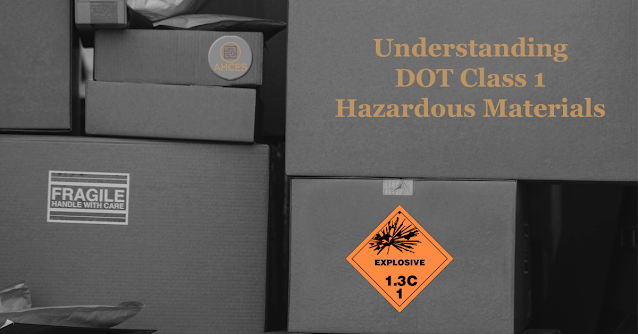
Definition of DOT Class 1: Explosives Class 1 covers explosive materials, meaning materials that can react to cause a rapid release of heat and gases. The formal definition can be found at 49 CFR 173.50 . Class 1 Divisions Class 1 materials are divided into six divisions. Division 1.1 Division 1.1 materials are a mass explosion risk, meaning that the entire amount of material is at risk of detonating in one event. Division 1.2 Division 1.2 materials are a projection hazard which do not risk a mass explosion. Division 1.3 Division 1.3 materials have both a fire hazard and either a minor blast hazard or minor projection hazard. Division 1.3 materials do not risk a mass explosion. Division 1.4 Division 1.4 materials have a minor explosion hazard, which is generally confined to the confines of the package. Division 1.5 Division 1.5 materials have a mass explosion risk but are highly insensitive to outside stimuli initiating an explosion. Division 1.6 Division 1.6 materials have o...

DOT Hazmat Emergency Response Information Guide

Image
  Emergency Response Information is important for the transportation of hazardous materials, as it ensures that emergency response personnel have the correct information on how to respond to an accident. For some materials, specific personal protective equipment or fire extinguishing material is needed for safe accident response. It is the duty of the party shipping the hazardous material to appropriately relay this emergency response information. What is Emergency Response Information for Hazardous Material Shipping? Emergency response information, in the context of a hazardous material shipment, is the information that needs to be readily available to emergency response personnel in the event of an accident involving the hazardous material. This includes technical information about the hazardous material, an emergency response telephone number, and carrier information contact. The full text of the requirements can be found in  49 CFR Part 172 Subpart G . Emergency Re...

DOT Hazmat Markings Guide

Image
  What is a DOT Marking? Markings refer to both identification markings that are material specific, as well as a set of pictograms with special instructions not otherwise covered in the Labels or Placards section. The regulations include specific fonts and sizes for letters and numerals, as well as specific pictograms and colors, for each Marking. The full text of the requirements can be found in  49 CFR Part 172 Subpart D . How is a DOT Marking Used? DOT Markings are used on all types of packages, both non-bulk and bulk, with different size requirements for clarity depending on package type. Proper Shipping Name and Identification Number There is a Proper Shipping Name and Identification Number. For each hazardous material, the proper shipping name and identification number can be found by looking it up in the § 172.101 Hazardous Materials Table. For example, if you are shipping nail polish remover that is made from pure acetone, then you would use the Proper Shipping N...

DOT Hazmat Placards Guide

Image
   What is a DOT Placard? Placards are pictograms that indicate the Hazard Class or Division of the hazardous material in a package, covering both the primary hazard and any subsidiary hazards. The regulations include specific pictograms and colors for each Placard. The full text of the requirements can be found in  49 CFR Part 172 Subpart F . How is a DOT Placard Used? A placard is generally applied to bulk packages, such as a rail car or freight container. Labels are utilized for non-bulk packages, such as compressed gas cylinders and fiberboard boxes. When applying a DOT placard, it is important that it must be visible and is not covered up by any other placard or signs that get applied to the container. It is also important that any designs on the container cannot be confused with the DOT placard. Therefore, it is best that hazardous materials are shipped in plain containers with minimal designs present. If multiple DOT placards are needed, the...

DOT Hazmat Labels Guide

Image
  What is a DOT Label? Labels are pictograms that indicate the Hazard Class or Division of the hazardous material in a package, covering both the primary hazard and any subsidiary hazards. Some labels also include special instructions, such as the "Cargo Aircraft Only" Label. The regulations include specific pictograms and colors for each Label. The full text of the requirements can be found in  49 CFR Part 172 Subpart E . How is a DOT Label Used? A label is generally applied to non-bulk packages, such as compressed gas cylinders and fiberboard boxes. Placards are utilized for bulk packages, such as shipping containers. When applying a DOT label, it is important that it must be visible and is not covered up by any other labels that get applied to the package. It is also important that any designs on the box cannot be confused with the DOT label. Therefore, it is best that hazardous materials are shipped in plain containers without any printed patterns. If...